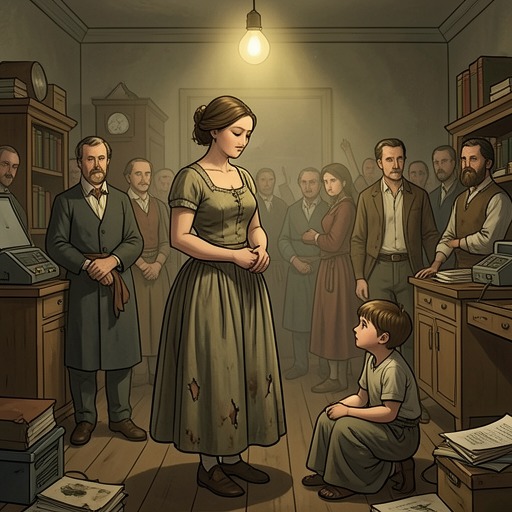
Louisa is expelled by her parents after becoming pregnant outside marriage
Blood ShotLouisa Djiak’s expulsion after becoming pregnant outside marriage exposed the cruelty of a community that treated an unmarried teenager’s pregnancy as a moral catastrophe. Against that judgment, Gabriella Warshawski offered public defiance and practical help; the episode’s aftermath shows that Louisa’s parents eventually admitted Caroline into their home without forgiving either mother or child.
Expulsion and Public Condemnation
Louisa was a frightened but resilient teenager when she told her parents she was pregnant. They threw her out and selected a home for unmarried mothers for her to enter, but she did not go. The episode is recalled against the period’s severe social expectations: V. I. Warshawski remembers girls from her high-school class returning from such homes with accounts of punishing labor, sparse rooms, and poor nourishment. Louisa’s refusal therefore meant resisting not only her parents’ decision but also a prescribed institutional response to pregnancy outside marriage.
The condemnation extended beyond the family. Neighbors marched in front of Louisa’s house, throwing eggs and shouting insults. Gabriella came out onto the front stoop and confronted them, challenging the gap between their Christian self-image and their treatment of a vulnerable young woman. V. I. remembers the scene with pride and anger: Gabriella’s intervention stood between Louisa and a crowd that had made public humiliation part of its judgment.
Gabriella’s Practical Support
Gabriella’s defense did not end with the confrontation. She helped care for Caroline so Louisa could work the night shift at the Xerxes plant. V. I. also helped look after the baby, making support a continuing, shared responsibility rather than a single dramatic gesture. The work and childcare give the episode a material dimension: Louisa had to earn a living while raising her child, and the people who stood by her helped make that possible.
Louisa’s parents later decided to acknowledge Caroline, but their acceptance remained conditional in feeling. When V. I. took the child to her grandparents, they made her remove her shoes before entering their house; on a couple of occasions, they bathed Caroline outside before allowing her inside. The careful policing of their home’s cleanliness contrasted with their reluctance to welcome the child without reservation. They did not forgive Caroline for being born or Louisa for having her.
Recollection and Significance
The episode surfaces years later through V. I.’s memories of Louisa and Gabriella. Recalling the neighbors’ conduct, she becomes furious at the way the adults had made Louisa suffer, then turns that anger into pride in her mother’s courage. The remembered acts of exclusion—being expelled, being denied an ordinary welcome, and being treated as a source of blame—are set against Gabriella’s sustained care.
The recollection also shifts the scale of judgment. Louisa’s pregnancy had once seemed to her family and neighbors like a calamity, while V. I. later observes that South Chicago faced widespread unemployment with consequences for the whole community. That contrast does not erase what happened to Louisa; it exposes how moral outrage had been concentrated on a teenager while hardship affecting many people was treated as ordinary. Gabriella’s response offers a different measure of responsibility: defend the person being shamed, and help with the work of keeping her and her child going.